Soil and Waste Pipe Sizes Explained
Which waste pipe size each appliance needs, how soil stacks and traps work together, and the falls to aim for.
Above-ground drainage problems are usually size, fall or ventilation problems rather than blockages. This guide sets out the pipe sizes normally used for each appliance, the trap seals that go with them, and how the soil stack keeps the whole system working quietly.
Waste pipe size by appliance
| Appliance | Usual pipe size | Trap seal |
|---|---|---|
| Basin | 32mm | 75mm |
| Sink | 40mm | 75mm |
| Bath | 40mm | 50mm (shallow trap common) |
| Shower | 40mm | 50mm |
| Washing machine / dishwasher | 40mm | 75mm |
| WC | 110mm soil | Integral in the pan |
Where several appliances share a branch, or a run is longer than usual, increasing the pipe size reduces the chance of the flow pulling the seal out of another trap. Never reduce pipe size in the direction of flow.
Falls and pipe runs
- Aim for a steady, gentle fall on waste runs — too steep can leave solids behind, too shallow will not clear
- Use swept bends rather than sharp elbows wherever the layout allows
- Fit an access point or rodding eye where a run cannot be cleared from the appliance end
- Support pipework at regular intervals so it cannot sag and hold water
- Allow for expansion on long solvent-welded runs
Soil stacks and ventilation
A soil stack does two jobs: it carries waste away and it lets air in behind the flow. Without that air, the falling water creates negative pressure that siphons water out of nearby traps — the usual cause of drain smells in a bathroom that was working fine before an appliance was added.
- Keep branch connections away from the base bend of the stack where turbulence is highest
- A vented stack terminating above the roof is the standard solution
- An air admittance valve can ventilate a stack internally where terminating outside is impractical
- Air admittance valves must remain accessible and located in a ventilated space
Shop the parts for the job
Where above ground meets underground
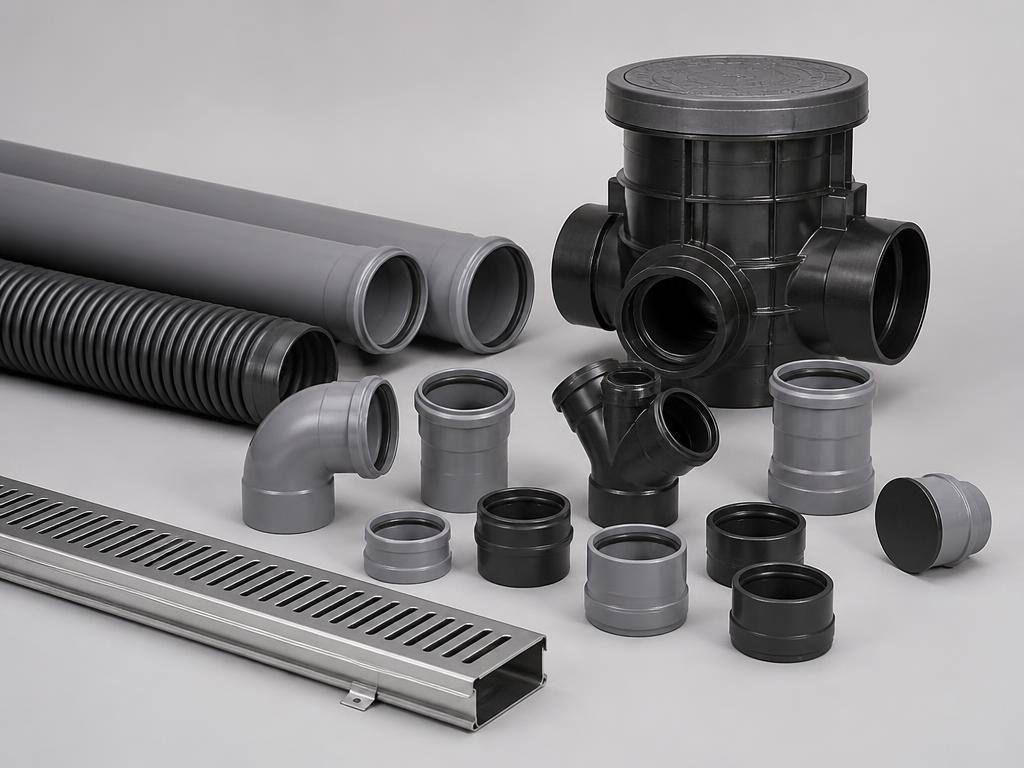
Below ground, 110mm pipe is the domestic standard, laid on and surrounded by bedding material and connected with push-fit couplers or adaptors at the stack base. Inspection chambers give access at changes of direction and junctions.
Related reading
Frequently asked questions
- Can I connect a bath waste into a 32mm pipe?
- No. A bath discharges far more quickly than a basin and needs 40mm as a minimum, with a shallow trap where depth under the bath is limited.
- Why does my bathroom smell after fitting a new shower?
- Usually a lost trap seal caused by siphonage or evaporation. Check the branch size, the trap depth and whether the stack is properly ventilated near the new connection.
- Is an air admittance valve as good as a vented stack?
- It resolves negative pressure and is widely used where an external terminal is impractical, but it does not relieve positive pressure. At least one stack on a system normally remains open to the outside air.
Shop the products in this guide
Plumb Supply Team
Practical buying information from the Plumb Supply team.