How to Choose a Kitchen Sink and Tap
A practical comparison of sink materials, bowl configurations, installation types and tap styles so the sink and tap you choose actually fit your worktop.
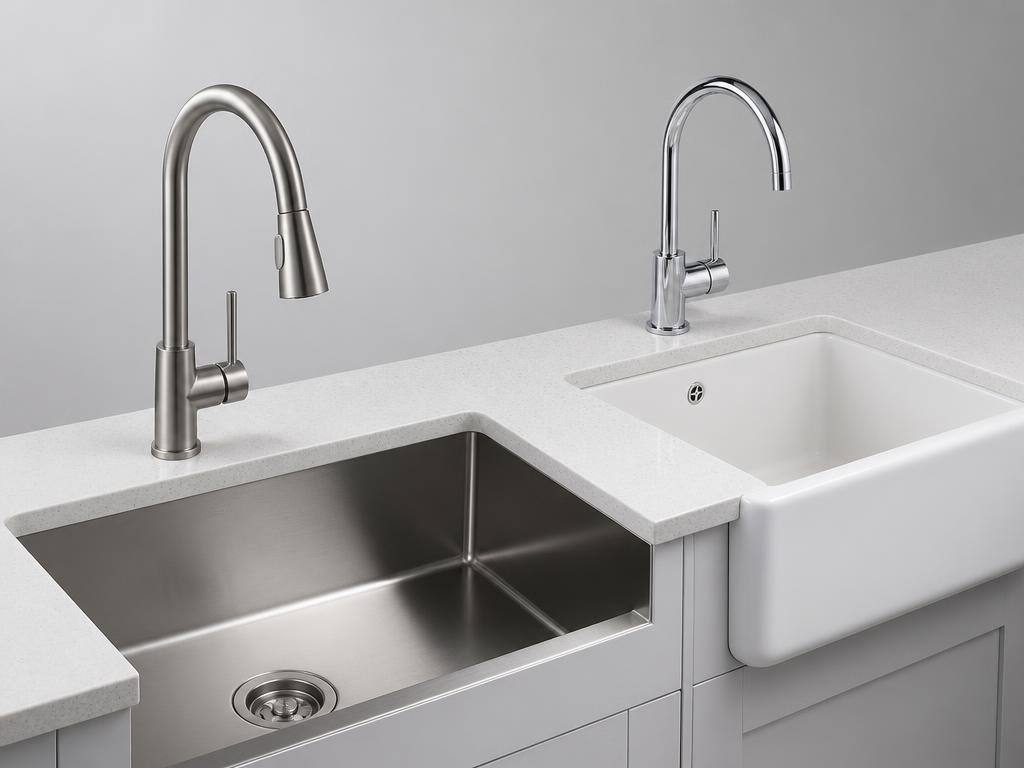
A kitchen sink and tap get used more than almost anything else in the house, so the choice is as much about daily practicality as looks. This guide covers sink materials, bowl layouts, installation methods and tap styles, plus the compatibility checks that stop a new sink or tap turning into a worktop-cutting problem.
Sink materials compared
Stainless steel remains the most common choice because it is inexpensive relative to its durability, resists heat and staining, and is straightforward to keep clean. Grade and gauge vary between products, and a heavier gauge steel is generally quieter and more dent-resistant, though this is not always stated clearly on a listing.
Ceramic sinks, usually fireclay, give a traditional look and a very hard-wearing glazed surface, but they are heavy and unforgiving if a glass or plate is dropped into them. Composite sinks — granite or quartz particles bound in resin — are scratch and stain resistant and come in a range of colours beyond plain white or steel, at a higher price than stainless steel of a similar size.
Belfast and butler sinks are deep, single-bowl ceramic sinks traditionally fitted without a worktop cut-out, sitting on cabinet supports with an exposed front. They suit period or farmhouse-style kitchens but need a tap with sufficient reach and clearance for the deep bowl, and a dedicated cabinet designed to take the weight and the front profile.
| Material | Durability | Noise level | Typical cost position |
|---|---|---|---|
| Stainless steel | Very good; can dent under heavy impact | Can be noisy without sound-deadening pads | Lower to mid |
| Ceramic (fireclay) | Excellent surface hardness; chips if struck hard | Quiet | Mid to higher |
| Composite (granite/quartz) | Very good scratch and stain resistance | Quiet | Mid to higher |
| Belfast / butler (ceramic) | Excellent surface hardness; heavy | Quiet | Mid to higher |
Bowl configurations
A single large bowl suits households that regularly wash bulky pans and oven trays, while a 1.5 bowl gives a full-size main bowl plus a smaller second bowl for draining, food prep or washing up separately from soaking. Double equal bowls are less common now but still useful where two tasks genuinely need to run side by side.
- Single bowl — maximum usable space for large items, simplest to fit
- 1.5 bowl — flexible everyday layout, small bowl often doubles as a colander rest
- Double bowl — useful for separating washing and rinsing, less common in modern kitchens
- Integrated drainer — reduces the need for a separate draining rack, but takes up worktop width
Installation types
How a sink sits in the worktop affects both the look and how easy it is to keep clean around the edges.
- Inset (top-mount) — the sink rim sits above the worktop surface; the most common and straightforward fit, suits laminate and most solid worktops
- Undermount — fixed beneath the worktop so water wipes straight from the surface into the bowl; needs a solid worktop such as quartz, granite or solid wood that can take the cut edge
- Sit-on (Belfast style) — the sink rests on cabinet supports rather than being cut into the worktop, with an exposed front face
- Flush-fit — sits level with the worktop surface for a seamless look; requires precise cutting and is usually specified with a matching solid surface
Tap styles
A mono mixer is the standard single-lever tap, drawing hot and cold through one body and one worktop hole. Pull-out and pull-down taps have a spray head on a flexible hose, useful for filling large pans or rinsing the sink itself, and work well over a single large bowl.
Boiling water taps deliver near-boiling water on demand from an under-sink tank, removing the need for a kettle for hot drinks and quick cooking tasks, though they need a dedicated electrical supply for the tank and periodic filter changes. Filter taps either combine filtration with the main mixer or run as a separate small tap alongside it, and need the under-sink filter cartridge replaced on a regular schedule to keep working effectively.
| Tap style | Best suited to | Extra requirement |
|---|---|---|
| Mono mixer | Everyday use, any sink type | Single tap hole |
| Pull-out / pull-down | Large single bowls, pan filling | Sufficient bowl depth to prevent splashing |
| Boiling water tap | Households wanting instant hot water | Dedicated electrical spur for the tank |
| Filter tap | Drinking water quality | Under-sink filter cartridge, periodic replacement |
Worktop and waste compatibility
Before ordering, check the tap hole layout the sink or worktop already has, and match it against the number of holes the new tap needs — a single mono mixer needs one hole, while some traditional or boiling water setups need two or three. Confirm the worktop thickness against the tap's fixing kit, as very thick solid surfaces sometimes need an extension kit.
- Match waste kit type to the bowl — basket strainer waste for a single bowl, or a linked waste kit where a second bowl or the dishwasher shares the same outlet
- Check whether the sink includes an overflow, as this determines whether a slotted or unslotted waste is needed
- Confirm tap and sink finishes are compatible if buying separately — mixed chrome and brushed finishes rarely look intentional
- Leave room under the sink for a boiling water tank, filter housing or waste disposal unit if any of these are planned
Shop the parts for the job
Water pressure requirements
Most mixer taps are designed for mains pressure or a pumped system and expect broadly balanced hot and cold pressure; taps fed from a low-pressure gravity cylinder can perform poorly or not mix correctly. Boiling water taps and some filter systems have their own minimum inlet pressure stated by the manufacturer, so it is worth checking your incoming supply before ordering rather than after installation.
Frequently asked questions
- Can I fit an undermount sink to my existing worktop?
- Only if the worktop material is a solid surface such as quartz, granite or solid wood that can support an exposed cut edge. Laminate worktops are not usually suitable for undermount fitting.
- How many tap holes do I need?
- A standard mono mixer needs one hole. Traditional two-tap arrangements, or a mixer paired with a separate filter or boiling water tap, need two or three holes, so check the sink or worktop configuration before ordering.
- Do boiling water taps need a special electrical supply?
- Yes, the under-sink tank needs its own dedicated electrical spur. This should be installed by a qualified electrician alongside the plumbing connection.
- What waste kit do I need for a 1.5 bowl sink?
- A 1.5 bowl typically uses a linked waste kit so both bowls drain through a shared trap, particularly useful if a dishwasher also connects into the same outlet.
Shop the products in this guide
Plumb Supply Team
Practical buying information from the Plumb Supply team.